National Grid G‑3 rates: compare coincident-peak billing
On National Grid G-3 you can pay transmission on every kWh, or on one hour a month. Which is cheaper depends on your load, and on whether a battery can find that hour.
Should your business choose coincident-peak billing?
On National Grid G-3 in Massachusetts, transmission is normally charged on every kWh you use. An optional election charges it on your usage during New England's monthly grid-peak hour instead. A facility that is quieter during that hour may pay less; one that is busy then may pay more.
A demand peak is a period when your facility draws its most power, measured in kW. Energy, measured in kWh, is how much you use over time: running 100 kW of equipment for two hours uses 200 kWh. See how demand peaks set your bill.
Coincident peak means your usage at the same time as the regional grid's peak. That hour can be different from your own busiest interval, and it is identified after the month ends. A battery can reduce your grid draw then, but it has to be available at the right time.
Compare example bills with and without a battery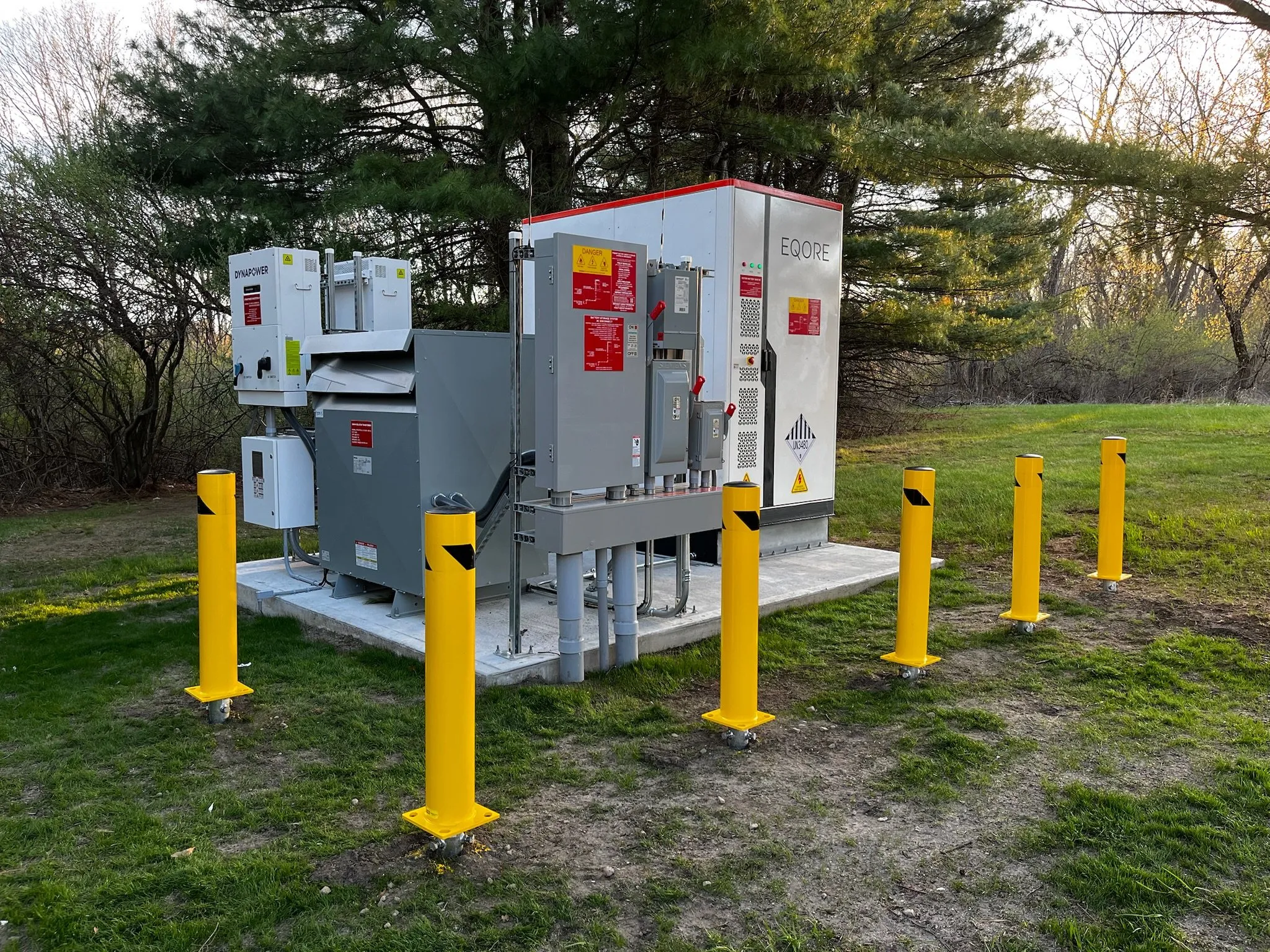
01
G-3 above 200 kW
National Grid's large time-of-use rate. Distribution demand is $10.61/kW on the highest 15 minutes between 8 AM and 9 PM on weekdays (or 90% of kVA, if higher). Nights, weekends and the nine listed holidays don't count.
02
Transmission per kWh, by default
Every kWh carries $0.03455 of transmission inside the delivery price. A battery shifts when you buy electricity rather than removing the equipment's energy use; charging losses can add a little usage.
03
Or on one hour a month
Elect coincident-peak billing and transmission becomes $21.91/kW on your 60-minute load in the hour New England's grid peaks that month. The election lasts at least 12 months.
Massachusetts Electric delivery rates, M.D.P.U. No. 1-26-I, effective October 1, 2026. Last reviewed October 26, 2026.
Compare both G‑3 billing options on an example facility
Choose an operating pattern to see annual bills with and without a battery. Then adjust usage or change how many monthly grid peaks the battery catches. You can explore without knowing your own load factor or demand.
Start with an example
Choose an operating pattern, then adjust the details below.
Day shift, quieter evenings
Adjust the example
Change one input to see what moves the bill.
Your busiest 15-minute interval, measured in kW.
What is peak demand?Peaky: short spikesFlat: steady all day
Average usage ÷ peak demand is called load factor.
Share of the peak still running then
With a 200 kW / 400 kWh battery.
Months the battery discharges through the regional grid peak.
Compare annual electricity bills
Same building and operations in both columns. The lowest eligible bill is marked in each column.
| Rate | Without battery | With battery |
|---|---|---|
| G‑3 standard | ~$623,000 | ~$599,000 |
| G‑3 coincident peak | ~$589,000Lowest bill | ~$521,000Lowest bill |
G-3 coincident peak has the lowest annual bill: about 10–15% below G-3 standard, or roughly 1.5–2 months of electricity a year.
The battery cuts the best bill by about 10–15% (roughly 1–1.5 months of electricity a year), and G-3 coincident peak stays the cheapest rate.
The battery column assumes it catches 10 of 12 monthly grid peaks. Adjust this below. Both options use the same supply price.
Why the operating pattern matters
This example uses less power in the modeled grid-peak hour than during production. That can make billing transmission on that hour attractive even without a battery. Compare both columns to see how much storage adds.
Explore the bill breakdown
G‑3 standard
~$599,000 / year
About 10–15% more
- Customer charge
- $4.2k
- Delivery energy
- $163k
- Supply
- $355k
- Distribution demand
- $76k
- Transmission, peak hour
- $0
G‑3 coincident peak
~$521,000 / year
Cheapest
- Customer charge
- $4.2k
- Delivery energy
- $77k
- Supply
- $355k
- Distribution demand
- $76k
- Transmission, peak hour
- $8.6k
Building loadFrom the grid, with the battery
To compare your own facility, use a year of 15-minute interval data: the record of when you used electricity and how much. It shows whether you were busy during past grid peaks. What interval data is and how to get it.
One hour a month, named afterwards
Under coincident-peak billing, the hour New England's grid peaks sets the whole month's transmission charge. It usually lands in late afternoon, but not always, and nobody knows which day until the month is over.
New England's monthly peak hour, October 2025 to September 2026
7 of the 12 fell in the 5–6 PM hour; two fell on a weekend. None is announced in advance.
- Oct 2025Mon, Oct 6, 6–7 PM, 15,935 MW
- Nov 2025Mon, Nov 17, 5–6 PM, 16,530 MW
- Dec 2025Mon, Dec 15, 5–6 PM, 19,474 MW
- Jan 2026Sun, Jan 25, 1–2 PM, 20,216 MW
- Feb 2026Sun, Feb 8, 5–6 PM, 20,182 MW
- Mar 2026Tue, Mar 3, 6–7 PM, 17,876 MW
- Apr 2026Thu, Apr 2, 7–8 PM, 15,123 MW
- May 2026Wed, May 20, 5–6 PM, 19,489 MW
- Jun 2026Fri, Jun 12, 5–6 PM, 22,772 MW
- Jul 2026Thu, Jul 2, 6–7 PM, 25,832 MW
- Aug 2026Fri, Aug 7, 5–6 PM, 24,191 MW
- Sep 2026Thu, Sep 10, 5–6 PM, 18,669 MW
Weekday peakWeekend peakG-3 peak hours: 8 AM–9 PM, weekdays
ISO-NE system peaks by hour ending, settlement basis; June to September 2026 are initially settled and can still be revised. Billing uses the Regional Network Load peak, which normally falls in the same hour.
Why the election is harder than it looks
The coincident-peak option can cut transmission sharply or cost more than it saves. The difference is load shape, forecasting and how the battery's energy is shared out.
01
Without a battery, it is arithmetic
The option is cheaper when a month's kWh divided by your kW in the system-peak hour exceeds about 634 hours ($21.91 ÷ $0.03455). In practice: for a month of about 730 hours, the grid-peak-hour load needs to stay below about 1.15× its average load.
02
With one, it is a forecast
The hour is identified only after the month ends. Catch it and the charge falls with every kW the battery covers; miss it and every kW running in that hour bills at $21.91 for the month. There is no switching back for 12 months.
03
Two targets, one battery
The same stored energy also has to hold your own weekday peak for the distribution charge, and summer afternoons are when ConnectedSolutions events and the capacity-tag hour land too. Planning one target well can mean missing another.
Rate election and battery dispatch have to be decided together. EQORE bills a full year of your interval data both ways, with and without storage, and against past system peaks, before recommending whether to elect.
As a first pass, facilities that fit typically save about 1–4 months of their electricity spend a year. It varies widely from site to site, and the real number takes a full analysis of your interval data.
The charges, side by side
| Charge | G‑3 (default) | G‑3 with coincident peak |
|---|---|---|
| Customer charge | $350.00/month | $350.00/month, plus $155 per manually produced bill |
| Distribution demand (weekdays 8 AM–9 PM) | $10.61/kW-month | $10.61/kW-month |
| Delivery energy, peak / off-peak | $0.06661 / $0.06388 per kWh | $0.03206 / $0.02933 per kWh |
| Transmission | $0.03455/kWh, inside the delivery price | $21.91/kW on the 60-minute load in the ISO-NE monthly peak hour |
| Term | Default | Elected; at least 12 consecutive months; billed one month in arrears |
Effective October 1, 2026 (M.D.P.U. No. 1-26-I). Last reviewed October 26, 2026.
The rate summary prints the full delivery price on the coincident-peak rows too; the tariff bills the option's transmission per kW "in lieu of" the per-kWh charge, so the delivery prices above leave the $0.03455 out. National Grid revises delivery rates several times a year: check the current summary before relying on a figure.
Questions about G‑3 and coincident peak
What is National Grid's coincident-peak transmission option?
An optional billing provision on Massachusetts Rate G-3. Instead of $0.03455 of transmission on every kWh, the customer pays $21.91/kW on its 60-minute demand in the hour of the ISO New England monthly transmission peak. It lasts at least 12 consecutive months and is billed one month in arrears. Rates effective October 1, 2026.
When does the ISO-NE monthly peak happen?
Usually on a weekday late afternoon or early evening: in the twelve months to September 2026 most monthly peaks fell between 5 and 7 PM, but January's came at 1 PM on a Sunday and February's was also on a Sunday. The hour is not announced in advance; it is known only once the month is over.
Is coincident-peak billing worth it without a battery?
Sometimes. It costs less than per-kWh transmission when a month's kWh divided by your kW in the system-peak hour exceeds about 634 hours. Sites that run steadily around the clock, or that are lightly loaded in late afternoon, can qualify; sites busiest in the late afternoon usually don't.
What happens if the battery misses the peak hour?
That month's transmission is billed on your actual grid draw during the peak hour, with no per-kWh fallback. In this comparison, a missed peak uses the grid draw remaining after the daily battery schedule, which may still reduce demand. Missing the hour can reduce the year's savings, and the billing election lasts at least 12 months.
Can a G-2 customer elect coincident-peak billing?
No. The option is in the G-3 tariff only. G-2 covers smaller demand-metered accounts up to 200 kW.
Put your rate in context
Sources (4)· Last reviewed October 26, 2026
- Massachusetts Electric, Summary of Electric Delivery Service Rates, M.D.P.U. No. 1-26-I, Sheet 3 (Rate G-3), effective October 1, 2026 (opens in a new tab)
- National Grid Rate G-3, M.D.P.U. No. 1591 (Optional Transmission Coincident Peak Billing), effective March 31, 2025 (opens in a new tab)
- National Grid, Basic Service rates, Industrial customer group (NEMA, variable price), November 2025 to October 2026 (opens in a new tab)
- ISO New England, Net Energy and Peak Load by Source, 2025 and 2026 (monthly system peaks) (opens in a new tab)
Take control of your power
Find out whether to elect coincident-peak billing
Send a recent National Grid bill. We bill a year of your interval data both ways, with and without storage, and show what each would have cost.